Monday, October 25, 2010

Web Updates

Over the next few weeks you will begin to notice changes to our website. We're in the process of updating product information including specifications, additional white papers and documentation, and eventually top SKUs. Here are a few improvements you can expect to see.

Easier Navigation with Direct Links to Products


Summary Information in a Quick View Format


Additional Detailed Product Specifications


If you have any questions about our product offering, additional solutions specs or just need a quote, please contact us at tssupport@nerdata.com

Friday, October 22, 2010

NER to Offer Bluestone’s Energy Incentive Services for Data Centers

NER now offers Bluestone’s Energy Conservation Services through a national network of resellers. These new services identify energy conservation measures in facilities, qualify the measures for appropriate utility incentives, and manage construction of projects, working closely with the utilities to bring incentive money to customers.

“Electric and gas utilities across the nation have created incentive rebate programs for their commercial and industrial customers to implement qualified energy saving projects. While these programs are readily available to customers, the variety and complexity of state rebate programs makes navigation and qualification difficult.” said Rob Huttemann, Vice President at NER. “With Bluestone’s help, we can take an energy conservation project from inception to completion, ensuring utility approval and lowering data center project costs for the customer.”

“The partnership with NER will make Bluestone services and solutions available on a much broader basis, and provide us a channel to share our expertise and experience with Utility incentives,” said Adam Fairbanks, Vice President of Business Development at Bluestone. “We have participated in utility programs for over twenty years and our engineers are skilled in qualifying efficiency measures for prescriptive, custom and comprehensive utility incentives. Last year we obtained over $4 million of incentives for efficiency projects at our customers’ facilities. We are confident in NER and their reseller partners’ ability to convey our story to a broad group of data center owners and operators.”

Data center power density grew an average of 15 percent per year over the past 10 years. This type of statistic is just one reason why NER is committed to providing environmentally responsible Solutions and Services that increase overall efficiency and reduce consumption.

Friday, October 8, 2010

New Emerson Network Power Innovation Partnership Program

As most of you are aware, Emerson is combining the channel programs from Liebert and Avocent. The new channel program called Emerson Network Power Innovation Partnership Program is set to formally launch Monday, October 11, 2010.

NER is expanding our offering to now include Liebert product solutions. You can expect the same level of quality and value-added support for Liebert that you are accustom to for Avocent.


- As an Emerson Distribution Partner, NER offers the full line of Avocent and Liebert channel products
- NER will continue assisting you with pricing, registration support, and order fulfillment
- You can submit orders to NER for both Avocent and Liebert products on the same order

--------------------------------------------------------------------------------

Emerson held a pre-launch webcast Monday October 5th to review details of the combined program. Below are key program highlights.

Increased Access to Products

- Avocent Take Command Partners gain access to the full offering of the Emerson channel products. This includes racks, rack power, single-phase UPS, and NFORM software
- Liebert Partners obtain access to the Avocent product offering, including new categories for Data Center Management products and Data Center Planning products

Program Updates

- Program partners are designated as either Silver, Gold or Platinum level
- Emerson sent to you an announcement explaining the new program levels along with discounting guidelines for the new channel product categories: EP1, EP2, EP3, EP4, and EP5
- Standard products, designated SP1 and SP2, do not require registration
- Specialty products and Avocent Care products require a call to NER
- All ‘channel’ products and discounts are available through NER

Improved Project Registration

- Access to Project Registrations will be available through the updated Partner Portal
- Improvements include the elimination of the minimum dollar-value thresholds and increased registration discounts on Liebert ‘channel’ products
- 24-hour quick approval process for smaller projects/transactions, and 72-hour standard approval process for larger projects that require coordinated authorization
- The improved Project Registration Portal will be in place for both Avocent and Liebert products Monday, October 11th

--------------------------------------------------------------------------------

NER is committed to supporting you and our partners at Emerson. Please let us know if you have any questions.

- NER and Emerson Regional Channel Managers are available to support you with training, marketing, and other areas of channel support
- Please see the NER Map or the Emerson Map for a complete listing of Managers and their territories
- NER will continue to provides access to comprehensive Technical Support and Customer Service

--------------------------------------------------------------------------------

We recognize your need to implement improvements and show ROI, which is why NER offers a complete line of Data Center products and services.

Thursday, September 30, 2010

Fan Assisted Floor Tiles


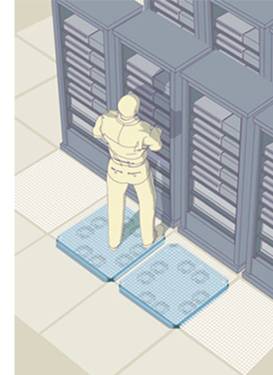
If sub-floor pressure is the factor for a cabinet overheating but it can not be relocated, there is a solution available. Smart fan assisted cooling can help remedy this issue. If the CRAC unit can not blow the cold air to the perforated tile, then draw it there with smart fan tiles that mount below the perforated tile.

Smart fan-assisted floor tiles utilize a temperature probe that is mounted in the target cabinet. This probe has set thresholds that act as a thermostat for the fan tile. The fan ramps up speed as the requirement increases. As the requirement decreases the fan will return to an idle speed.

It is critical to make sure that there is enough cooling capacity to support the data center load, otherwise fan tiles will only relocate the hot spot. It is also important to know that fans require power and therefore produce heat which is why you should install a variable speed fan tile that ramps up fan speed only when it is required.

The figure below illustrates how the fan assisted floor tile extracts the air from the sub-floor no matter what the sub-floor pressure is. The results (purple plume) are dramatic compared to the (yellow plume) passive perforated tile next to it.

Intelligent air movers for the exhaust air are also available. Much like the floor tile, the ducted fan utilizes a temperature probe to control fan speed. The air mover is placed above the suspended ceiling. 12” flex duct is routed from a ceiling vent placed above a hot spot, to the unit, and exhaust from a ceiling vent placed above a CRAC unit.

To learn more, click here.

Wednesday, September 22, 2010

NER National Sales Meeting

NER Data Corporation will be holding it's annual National Sales Meeting Sunday 9/26 thru Tuesday 9/28. Our entire team of field sales representatives will be in attendence. As a result, there may be a short delay in answering your voicemails and emails.

If you have immediate needs or questions, please contact our inside support team.


Technical Support
TSSupport@nerdata.com

Custome Service
TSPurchasing@nerdata.com

We want to thank you in advance for your patience!

Tuesday, September 21, 2010

Using Floor Tiles with Increased Perforation


Servers and other racked equipment are more than capable of cooling themselves with onboard fans. This equipment has a three part set of cooling specifications requiring the data center to supply.

- The first is air temperature typically between 65˚F and 80˚F.
- 30%-60% relative humidity (some experts prefer the higher air density that 60% RH has to offer however, there is a higher energy consumption associated with the production of humidity).
- CFM: 1 kW equals 120CFM to maintain a 20˚F delta through the device.

The percentage of perforation of the floor tile in conjunction with the sub-floor air pressure will dictate the amount of air that can flow through it. Increasing the percentage of perforation can increase the amount of air that the tile can flow, so why not replace all of the perforated floor tiles with 56% perforated grates? The answer; the sub-floor pressure may drop to the point where air delivery in sections of the data centers will depreciate greatly.

In the model below the top pane uses a single 56% perforated tile. The flow is increased through the 56% perforated tiles relatively. In the lower pane all of the perforated tiles are 56% perforated. The air flow varies greatly due to a drop in sub-floor pressure.

The key here is moderation. Place the higher perforated tiled in front of the higher density enclosures which require them. As mentioned above, 120cfm of air will maintain a 20˚F delta for a 1kW load. How can you tell if you are doing it right?

1. Measure the electrical load of the enclosure you are trying to cool. This can be done by multiplying the current reading on the power strip meters by the voltage of the power in the strips. Example: 22amps x 208volts= 4,576watts or 4.576kW.

2. Now multiply the 4.567kW by 120cfm = 548cfm of air required

3. Now you will need to use a tool called a “Flow Hood Balometer”. This flow hood has a 2’x2’ square box that fits over the 2’x2’ perforated floor tile. Inside the flow hood box is a meter that measures the amount of air flowing through it. These flow hood may be able to be rented from your local rental facility otherwise they rage from $800-$3000 new.

4. Adjust the percentage of perforation to match the airflow requirement as closely as possible. Some perforated floor tiles have an adjustable baffle that you can use to change the airflow of the tile.

5. Let the tile sit for about 20-30 minutes and return to take temperature readings at the front top, middle, and bottom of the cabinet. If any of the temperatures exceed 80˚F you may have to increase the cfm of air flow through the tile. You may also need to correct some in-efficiencies discussed further in this document.

6. Another option is to have a data center professional conduct a Computational Fluid Dynamic (CFD) study on your data center which can provide all of this information.